In the quiet town of Homestead, Florida, stands an architectural marvel that has puzzled visitors and experts for nearly a century: Coral Castle. Built in the 1920s by Edward Leedskalnin, a solitary Latvian immigrant with no formal engineering training, this sprawling complex of carved coral rock defies conventional understanding.
Massive stones, some weighing as much as 30 tons, are meticulously arranged into walls, towers, and intricate sculptures, all crafted by one man working alone. Leedskalnin’s creation is not just a testament to human determination but a source of enduring mystery, as he claimed to have used unconventional methods—possibly even anti-gravity construction—to achieve the impossible.
The enigma of Coral Castle lies in its creator’s secrecy and the sheer scale of his accomplishment. Leedskalnin, a slight man of modest means, worked under the cover of night, leaving no witnesses to his process. His cryptic references to ancient knowledge and magnetic forces have fueled speculation, with some suggesting paranormal or extraterrestrial influences.
Today, the site remains a magnet for engineers, historians, and curious minds drawn to its unanswered questions. This exploration traces the history of Coral Castle, examines Leedskalnin’s extraordinary claims, and unravels the intrigue that continues to captivate those who encounter this Florida landmark.
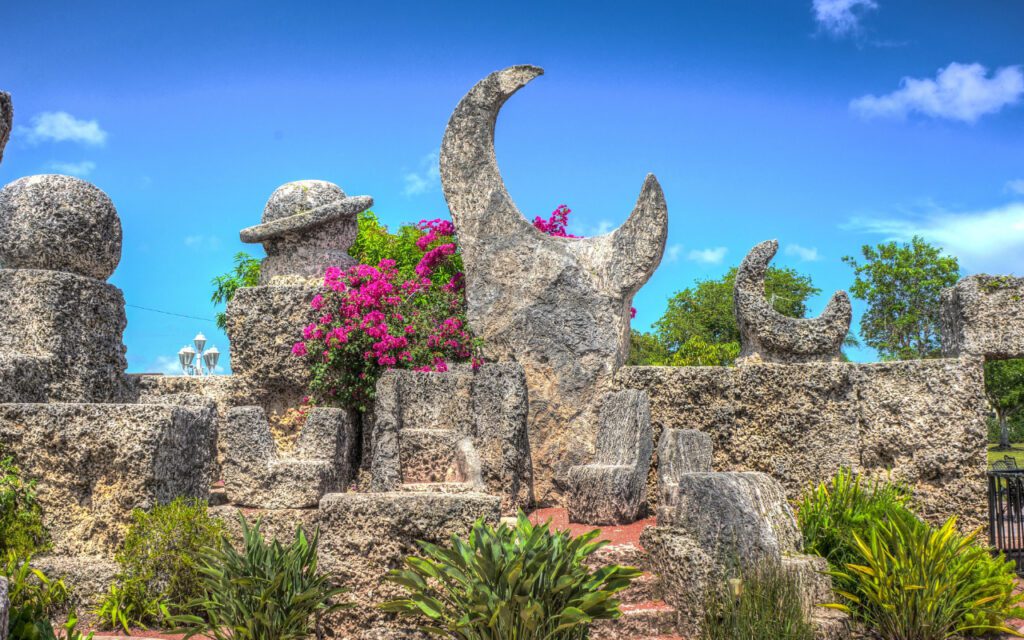
Image by Michelle Pitzel from Pixabay
https://pixabay.com/users/michelle_pitzel-165491/
A Latvian Immigrant’s Vision
Edward Leedskalnin, the enigmatic creator of Coral Castle, was an unlikely figure to leave such an indelible mark on the landscape of Homestead, Florida. Born in 1887 in a small village near Riga, Latvia, Leedskalnin grew up in a modest farming family. With only a fourth-grade education, he possessed no formal training in engineering or architecture, yet his insatiable curiosity and relentless determination set him apart.
At the age of 26, he immigrated to the United States, seeking opportunity after a personal setback that would shape his life’s work. A diminutive man, standing just five feet tall and weighing barely 100 pounds, Leedskalnin’s physical stature belied the monumental ambition that drove him to create a stone complex that continues to baffle experts.
The spark for Coral Castle, according to local lore, was a deeply personal one: a broken engagement to Agnes Scuffs, a young woman Leedskalnin referred to as his “Sweet Sixteen.” In his early 20s, he had planned to marry her in Latvia, but she called off the wedding on the eve of their nuptials, reportedly deeming him too old and poor.
Devastated, Leedskalnin channeled his heartbreak into an extraordinary endeavor, vowing to build a monument that would stand as a testament to his lost love. This emotional wound became the cornerstone of his vision, transforming his grief into a creative force. He often described Coral Castle as a tribute to his unfulfilled romance, with some of its features—like a heart-shaped table—hinting at this poignant inspiration.
Leedskalnin’s journey to create Coral Castle began in the early 1920s in Florida City, a small community south of Miami.
Working alone, he started quarrying and shaping massive blocks of coral rock, a porous but heavy material native to the region. His methods were shrouded in secrecy, and he labored primarily at night, away from prying eyes. By 1936, facing encroachment from nearby development, Leedskalnin decided to relocate his partially built castle to a more secluded plot in Homestead, about 10 miles away.
The move itself was a feat of ingenuity: he transported the colossal stones—some weighing up to 30 tons—using a borrowed truck and rudimentary equipment, reportedly without assistance. This relocation, completed over several years, underscored his unwavering commitment to his vision.
In Homestead, Leedskalnin continued to expand and refine Coral Castle, sculpting intricate structures and furniture from the coral rock. His work was not merely functional but artistic, with features like a sundial, a telescope aligned with the North Star, and a massive crescent moon carving.
He lived frugally on the property, sustaining himself with minimal resources while dedicating his days and nights to the castle. This solitary labor continued until his death in 1951, when he passed away at the age of 64 in a Miami hospital, leaving behind an unfinished masterpiece. Over the course of three decades, Leedskalnin’s relentless pursuit had transformed a personal dream into a physical reality, one that weighed over 1,100 tons and covered several acres.
The timeline of Coral Castle’s creation reflects Leedskalnin’s extraordinary perseverance. From its humble beginnings in Florida City in the early 1920s to its relocation and expansion in Homestead through the 1930s and 1940s, the project spanned nearly his entire adult life in America.
Despite his lack of resources, formal education, or manpower, Leedskalnin’s vision never wavered. His background as a Latvian immigrant, marked by resilience in the face of adversity, shaped his ability to undertake such an improbable task. The castle stands not only as a monument to his lost love but also as a symbol of what one determined individual can achieve against all odds.
The story of how he accomplished this, however, remains one of the enduring mysteries that continues to draw attention to this Florida landmark.
The Enigma of Construction
The sheer scale of Coral Castle in Homestead, Florida, is enough to inspire awe.
Spanning several acres, the complex comprises over 1,100 tons of coral rock, a dense, limestone-like material quarried from the local ground. Edward Leedskalnin, a lone amateur with no formal engineering background, sculpted and arranged this massive volume into an intricate array of structures: towering walls, a 9-ton swinging gate, a 30-ton crescent moon, and even functional furniture like tables and chairs.
Some individual stones weigh as much as 30 tons—equivalent to a fully loaded semi-truck—yet were precisely positioned to create a balanced, harmonious layout. The magnitude of this achievement, accomplished single-handedly in the 1920s and 1930s, challenges conventional understanding of what one person could physically accomplish without modern machinery.
Leedskalnin’s own explanations for his methods only deepen the mystery.
He claimed to have unlocked secrets of construction that allowed him to move and place these enormous stones with ease. Among his most provocative assertions was the use of anti-gravity construction, a concept that defies known physics. He hinted at harnessing magnetic forces or tapping into ancient knowledge, possibly inspired by the builders of the Egyptian pyramids or Stonehenge.
In conversations with visitors, he spoke cryptically of “magnetic currents” and the “sweet spot” of leverage, suggesting he had discovered a lost science. Yet, he offered no detailed blueprints or demonstrations, leaving his claims tantalizingly vague. Some neighbors reported seeing stones “float” into place, though these accounts remain anecdotal and unverified, adding to the lore surrounding his work.
Secrecy was a hallmark of Leedskalnin’s process, further fueling speculation. He worked almost exclusively at night, shielded by darkness and solitude, ensuring no one witnessed his techniques.
When curious onlookers approached, he would stop working, politely but firmly discouraging observation. This deliberate isolation meant that no contemporary records or testimonies exist to explain how he quarried, transported, and positioned the massive coral blocks. Even during the castle’s relocation from Florida City to Homestead in the 1930s, a distance of 10 miles, Leedskalnin reportedly managed the transport of multi-ton stones alone, using only a borrowed truck and basic equipment. His refusal to share his methods, coupled with the absence of witnesses, has left a void that invites both rational and fantastical theories.
After Leedskalnin’s death in 1951, investigators found only rudimentary tools at the site: wooden tripods, pulleys, chains, and a hand-cranked winch.
These implements, while ingenious for their simplicity, are deemed wholly inadequate by modern engineering standards for lifting and maneuvering stones of such weight and size.
For comparison, moving a 30-ton block today would typically require a heavy-duty crane or hydraulic equipment—technology unavailable in Leedskalnin’s era. Engineers who have studied the castle note the precision of the stone placements, such as the 9-ton gate, which was so perfectly balanced it could be opened with a single finger until its bearings wore out decades later.
The mismatch between the tools found and the task accomplished has led many to question whether Leedskalnin relied on undisclosed techniques or forces beyond conventional mechanics.
Leedskalnin’s claims of anti-gravity construction and magnetic manipulation, while dismissed by mainstream science, have kept the enigma of Coral Castle alive. His insistence on working alone and in secret ensured that the full truth of his methods died with him, leaving behind a puzzle that continues to captivate.
The rudimentary tools he left behind only deepen the intrigue, as they fail to account for the precision and scale of his work. Whether his success stemmed from an undiscovered scientific principle, extraordinary ingenuity, or something more esoteric, the construction of Coral Castle remains one of the most perplexing feats of the 20th century, inviting ongoing scrutiny and wonder.
Scientific and Paranormal Theories
The construction of Coral Castle in Homestead, Florida, has long confounded engineers and scientists attempting to unravel how Edward Leedskalnin, a solitary man with no formal training, managed to quarry, move, and precisely place over 1,100 tons of coral rock.
Engineering studies conducted over the decades have yielded more questions than answers.
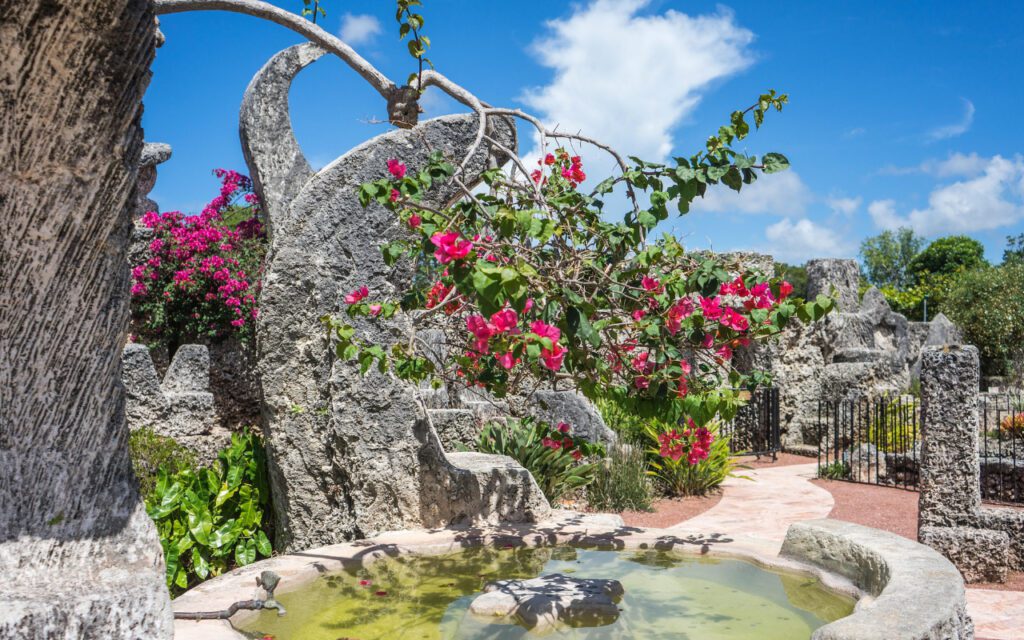
Image by Michelle Pitzel from Pixabay
https://pixabay.com/users/michelle_pitzel-165491/
Experts note that lifting a single 30-ton stone—let alone positioning it with the precision seen in the castle’s 9-ton swinging gate or intricately balanced sculptures—would typically require industrial machinery like cranes or hydraulic lifts, none of which were available to Leedskalnin in the 1920s and 1930s. Analysis of the site reveals no evidence of such equipment, only basic tools like pulleys and chains, which modern engineers deem insufficient for the task.
Some have hypothesized that Leedskalnin employed advanced leverage techniques or an undiscovered mechanical advantage, but no definitive model explains the full scope of his achievement. The precision of the stonework, such as the telescope aligned with the North Star, further complicates efforts to attribute the work to simple ingenuity alone.
Beyond the realm of conventional science, paranormal theories have flourished, offering alternative explanations for Coral Castle’s creation.
Some enthusiasts propose that Leedskalnin tapped into mystical forces, perhaps channeling energy fields or ley lines believed to intersect at the site. Others speculate about extraterrestrial influences, suggesting that Leedskalnin received otherworldly guidance or technology to accomplish his feat.
These ideas draw from reports of strange lights or unexplained phenomena in the area, though such accounts lack corroboration. The castle’s otherworldly aura is enhanced by its creator’s own cryptic statements, which some interpret as hints of supernatural knowledge. While mainstream scholars dismiss these theories as fanciful, they resonate with those drawn to the possibility of unexplained forces, keeping Coral Castle a focal point for paranormal speculation.
Leedskalnin’s own writings add a layer of intrigue to the debate. In self-published pamphlets, he referenced “magnetic currents” and claimed to have rediscovered principles used by ancient builders, such as those who constructed the pyramids or Stonehenge. His texts, however, are frustratingly vague, filled with abstract diagrams and poetic musings rather than practical instructions. He described manipulating magnetic forces to move heavy objects, yet provided no replicable experiments or clear methodologies.
Some researchers interpret these writings as metaphorical, suggesting Leedskalnin used the language of magnetism to describe mechanical techniques he kept hidden. Others see them as evidence of esoteric knowledge, possibly rooted in lost sciences or spiritual insights. His reluctance to clarify his methods, even in writing, ensures that his words remain a tantalizing puzzle, open to both scientific and mystical interpretations.
The tension between rational explanations and unexplained phenomena lies at the heart of Coral Castle’s enduring fascination.
On one side, engineers and historians argue that Leedskalnin’s success, while extraordinary, must stem from clever mechanics, perhaps involving counterweights, fulcrums, or an ingenious use of the coral rock’s natural properties. Experiments have shown that a determined individual could, in theory, move heavy stones with basic tools, though scaling this to Leedskalnin’s level remains daunting.
On the other side, proponents of paranormal theories point to the absence of conclusive evidence for conventional methods, arguing that Leedskalnin’s claims of anti-gravity construction or magnetic manipulation warrant serious consideration.
Decades of study have failed to produce a consensus, with each new investigation reigniting debates. Was Leedskalnin a mechanical genius who outsmarted the limitations of his era, or did he tap into forces beyond current scientific understanding?
The lack of definitive answers ensures that Coral Castle remains a battleground for competing worldviews. Engineering analyses continue to probe the site, seeking clues in the stonework or Leedskalnin’s tools, while paranormal investigators explore its energy fields and historical anomalies. The mystery is compounded by the fact that no one has fully replicated Leedskalnin’s feats under similar conditions, leaving both camps without a conclusive resolution. This ongoing debate reflects the castle’s unique place in the public imagination: a tangible marvel that invites scrutiny from all angles, yet resists easy categorization.
Whether viewed through the lens of science or the supernatural, Coral Castle challenges assumptions about what is possible, keeping its secrets just out of reach.
Coral Castle - A Lasting Legacy
Today, Coral Castle stands as a vibrant tourist attraction in Homestead, Florida, drawing a diverse crowd of engineers, historians, and paranormal enthusiasts eager to explore its enigmatic stone structures.
Maintained as a historic site, the castle welcomes visitors to wander through its towering walls, marvel at the 9-ton swinging gate, and ponder the heart-shaped table carved from coral rock. Informative tours highlight Edward Leedskalnin’s solitary labor and the unanswered questions surrounding his methods, while the on-site museum displays his simple tools and cryptic writings. For engineers, the site is a real-world puzzle challenging modern construction principles; for historians, it’s a window into one man’s extraordinary determination; and for those intrigued by the unexplained, it’s a place where the boundaries of possibility seem to blur.
The castle’s accessibility ensures it remains a living testament to its creator’s vision, inviting new generations to grapple with its mysteries.
The cultural impact of Coral Castle extends far beyond its physical boundaries, cementing its place in the broader narrative of unexplained phenomena. It has been featured in numerous documentaries, from PBS specials to series on the History Channel, each probing the enigma of Leedskalnin’s anti-gravity construction claims.
Books exploring the world’s great mysteries often dedicate chapters to the castle, weaving its story into discussions of ancient megastructures and lost technologies. Television shows, including episodes of Ancient Aliens and In Search Of, have spotlighted the site, amplifying speculation about mystical or extraterrestrial influences.
These portrayals have transformed Coral Castle into a cultural touchstone, synonymous with the allure of the unknown, and have helped sustain public fascination with Leedskalnin’s achievement.
Reflecting on Leedskalnin’s work, Coral Castle stands as a remarkable testament to human ingenuity, regardless of how he accomplished it. Whether he employed ingenious mechanical techniques, undiscovered scientific principles, or something more esoteric, his ability to quarry, transport, and sculpt over 1,100 tons of coral rock alone is a feat of unparalleled dedication.
The castle embodies the power of individual resolve, proving that one person, driven by passion and perseverance, can create something that endures for centuries. Leedskalnin’s creation transcends the debate over its methods, serving as a universal symbol of what humanity can achieve when fueled by an unwavering vision, even in the face of skepticism or adversity.
The enduring allure of Coral Castle lies in its unique ability to bridge history, science, and the paranormal, captivating all who encounter it. It is a place where tangible evidence—the massive stones, the balanced gate, the carved telescope—coexists with intangible questions about how it all came to be.
Visitors leave with a sense of wonder, inspired by the blend of meticulous craftsmanship and unresolved mystery. As a historic landmark, it preserves Leedskalnin’s legacy; as a scientific enigma, it challenges conventional wisdom; and as a paranormal phenomenon, it invites imagination.
Nearly a century after its creation, Coral Castle continues to captivate, reminding us that some mysteries, like the stones themselves, are immovable, eternal, and profoundly human. Recognized for its historical and architectural significance, Coral Castle was added to the National Register of Historic Places in 1984, cementing its status as a cultural landmark.